전체 공개 ・ 07.31
2026.07.31 (Fri)
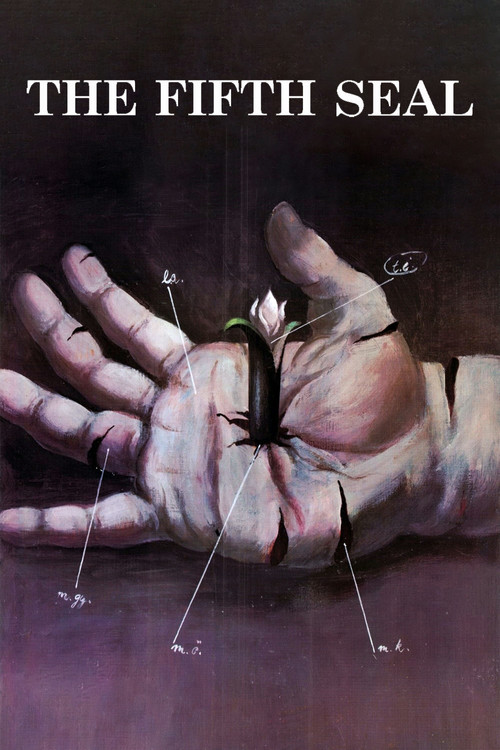
The Fifth Seal is a film that portrays the moral dilemmas existing within every human being, revealing the parts of ourselves we often try to deny just so we can continue seeing ourselves as respectable people with a good moral conscience. The film revolves around a single question that, at first glance, seems simple enough to answer without much thought, at least if we treat it as nothing more than a hypothetical: "Would you rather be reincarnated as a vicious, monstrous tyrant, or as a tortured slave who must sacrifice everything they have, but in return possess a clear moral conscience? Well, if we see it as merely a hypothetical question, the answer seems obvious. But the moment we stop treating it as a mere hypothetical and begin weighing it against our own morals and conscience, it gets more and more complicated. I know this because I couldn't bring myself to give a definite answer either. The more I thought about it, the more it made me question my own morality and whether I'm really as decent a human being as I had always believed myself to be. And I don't want to be the only one who feels that way, so I hope you'll be just as lost as I am when you read this "review" :P You see, as human beings, we've always been taught to distinguish between what's good and what's bad, what's evil and what isn't. Those teachings shape the way we think, leading us to avoid anything that goes against the values we've grown up with. We come to believe certain things are inherently good simply because we've always been taught to see them that way. Long before we're able to understand those values for ourselves, we're already taught to accept them as the truth. Many of us end up doing what's considered "right" simply because we've been told it is before we ever get the chance to ask why it's right in the first place, or why one choice is considered more moral than another. We were never prepared for the possibility that, as we grow older and begin questioning those beliefs, everything that was always taught to us starts to feel uncertain. The things we once accepted without a second thought suddenly don't make as much sense anymore, and we're left wondering what we're actually supposed to believe. Take religion, for example. Many of us, especially those raised in religious families, were taught to be kind and avoid doing bad things because God wouldn't want us to do otherwise. But we weren't always taught why those actions were good beyond that. We were expected to accept the answer without questioning it. So when someone begins to doubt their faith, it's not uncommon for them to question the moral values they built on top of it as well. If morality was something we were only taught to follow rather than something we truly understood, then once the foundation starts to crumble, everything built upon it can begin to fall apart too. The things we've always been taught also shape the way we behave. They shape our idea of what makes someone respectable, what makes someone worthy of being called a "good" person. Before we even get the chance to figure it out for ourselves, we're already handed a standard of morality that we're expected to follow. Because of that, we often feel the need to perform, we hide the parts of ourselves that don't fit the version we want other people to see, we become less truthful, less genuine, all for the sake of being seen as righteous. So when we're faced with a question like this, just like the four men in the film, most of us will instinctively choose the latter. Not because we've truly confronted the question, but because we've already been taught which answer is supposed to be the "right" one. We might even convince ourselves that it is our honest answer, simply because admitting otherwise would force us to question the image of ourselves that we've spent our whole lives trying to protect. The men constantly justify their choice by arguing that the one who is treated as a slave, someone seen as far beneath everyone else, at least gets to keep a clear conscience. They don't hurt anyone. They don't ruin other people's lives. No matter how much they suffer, they can still hold on to the belief that they remained morally good. To them, that alone is enough to make the choice obvious. A clear conscience is worth more than power, comfort, or even freedom. Yet the more they try to explain it, the more it becomes clear that none of them is completely certain. Their reasons begin to sound less like convictions and more like attempts to reassure themselves that they're making the "right" choice. And as each one of them goes back home and has some time alone, or with the people who most likely won't judge them for who they truly are, they begin to question their own answer and grow more and more uncertain. They start to realize that living in Gyugyu's shoes is anything but a convenient life. He has to give up his children to his master, watch his wife be killed, and even allow his eyes to be gouged out. When the reality of that life begins to sink in, the certainty they once had slowly starts to disappear. Some of them even begin to reveal what they truly think. Once the realization hits, they admit that perhaps it is better to be Tomóceusz Katatiki, the tyrant, if it means they don't have to suffer. Even if it requires them to be cruel, to destroy other people's lives, or to become the very embodiment of evil, they realize that a life free from suffering can be far more tempting than such an abstract concept as "conscience." They come to see that choosing Gyugyu would only make them hypocrites, and they're convinced that no sane person would willingly choose a life of such unbearable suffering. And that made me wonder: do we choose what is "right" because we truly believe it's right, or because, in one way or another, it's still the more convenient choice? And if it isn't convenient, do we simply reshape our morality until it becomes convenient for us? What if being righteous, what if being kind, truly meant suffering? What if it required us to give up everything we have? Would anyone still choose it? And if everyone had the chance to avoid suffering, would anyone willingly embrace it instead? Because, even in reality, many people like Gyugyu suffer not because they choose to, but because they have no other choice. Their circumstances never allow them one. But if they were given the choice, would they still choose the very same path? The men also keep bringing up how wrong it is to be someone like the tyrant. They keep questioning whether he'd ever feel guilty for everything he's done, and they simply can't understand how a man like that could still sleep peacefully at night. To them, it's unimaginable that someone could commit such horrific acts and remain completely at ease with themselves. But then Mr. Gyurica, the one who first raised the question, offers a different perspective. He argues that the tyrant doesn't feel guilty because he doesn't even realize that what he's doing is wrong. He has never known guilt to begin with. From his point of view, his actions aren't evil at all, they're simply the way the world works. It made me come up with another hypothetical question (please forgive me and my weirdly-wired brain, I guess...) 1. if we lived in a completely different world where everything the tyrant does—killing people, destroying lives, exploiting others—was considered right and normal, where no one would ever call those actions evil and no one would condemn us for doing them, would we still choose to avoid them? 2. If no one ever taught us what guilt was, if no one ever told us that those actions were wrong, would we still develop that same sense of morality on our own? Or would we become just like Tomóceusz Katatiki, believing we had done nothing wrong simply because that was the only reality we had ever known? Well, you see, we often think of morality as something deeply personal, something that comes from within us. But how much of our conscience is truly our own, and how much of it is shaped by the world around us? (Please tell me that it does makes any sense). ANYWAY... I think that's enough of me spiraling over a hypothetical question and having an existential crisis because of a two-hour Hungarian film LOL. I still don't have an answer, and honestly, I don't think I ever will, in fact. Now, if we're talking about the film itself, I genuinely think it has some of the best writing I've ever seen. Rather than spoon-feeding the audience an answer, it trusts us to wrestle with the question ourselves. It doesn't tell us what to think, and instead, it forces us to think. It leaves us to confront our own beliefs, our own contradictions, and our own hypocrisy, just as I found myself doing throughout the entire film... 😅 The dialogue is easily my favorite part. Every conversation feels so carefully written that I found myself constantly pausing just to write things down. I ended up filling around 15 pages of my notebook with magnificent dialogues from the film and my own thoughts as I tried to make sense of everything. I understand very well that it might be boring to some since it only shows people spend most of the runtime simply talking, but I personally like it since it doesn't feels somewhat boring and instead incredibly tense because every word carries so much weight in it. The acting deserves just as much praise. Despite how philosophical and heavy the script is, the performances never feel artificial or like the actors are simply delivering a philosophical lecture—and I think this helps a little to make it less boring (again, for me, at least). And, as per usual, I read a bunch of Letterboxd reviews both before and after watching it. A lot of people talked about how mentally exhausting this film is, to the point that it made them want to slap themselves (literally or figuratively), and I couldn't agree more. I felt exactly the same way. By the time it ended, my brain genuinely felt drained from trying to process everything it was throwing at me. 😮💨 Dare I say, The Fifth Seal is one of the greatest films I've ever watched, and I highly encourage anyone who happens to read this review to give it a watch too!!
 ayiya
ayiya