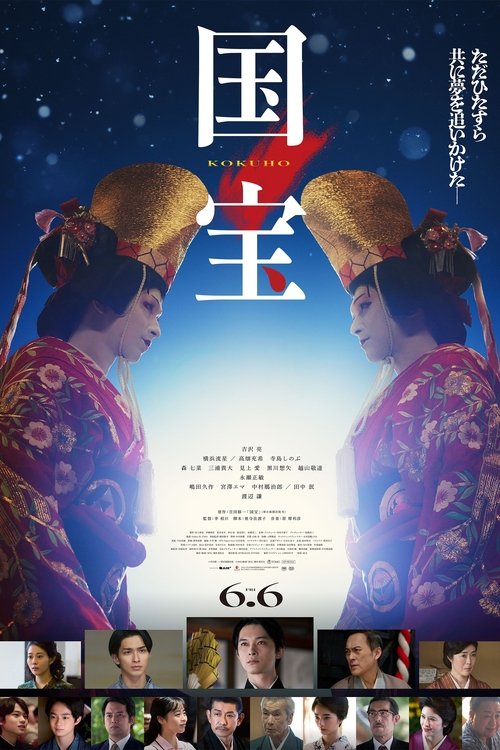
Magical. Cultured. Dedicated. Those are the three words that kept popping into my head while watching "Kokuho".
"Kokuho" follows Kikuo, a yakuza’s son in 1964 Nagasaki, Japan. After his father dies in a brutal massacre, he’s taken in by a legendary Kabuki actor who sees something special in him, especially his potential as an onnagata (a male Kabuki performer who plays female roles, kind of like a traditional theatrical drag queen figure). Under his new 'father’s' guidance, Kikuo trains alongside the actor’s biological son, Shunsuke. Without even realizing it, Shunsuke becomes his lifelong bro-companion aka soulmate, sometimes a friend, sometimes a brother, sometimes a rival.
With a runtime of almost three hours, this is the first film in a while that I genuinely couldn’t look away from. Every scene felt important. I believe if I blinked for two seconds, I'll miss a crucial line. I went in knowing almost nothing about Kabuki performance beyond the white makeup and dramatic expressions (which, if I’m honest used to scare me a lot). But after this? I completely fell in love with its beauty. It feels like watching an utsukushii monster: something beautiful, intense, and slightly terrifying all at once.
For me, this film delivers everything I want from a 5-star cinema experience: a complete and cohesive story with no distracting plot holes, meaningful life lessons about culture and ambition, and hypnotic cinematography/visuals. I was honestly torn between giving it 4.5 or 5 stars, but in the end, it earned the full five. The story really emphasizes how life moves in cycles. We’re not always at the top of the wheel. If someone who’s worked tirelessly for years can fall to the bottom, why wouldn’t someone else? Luck exists. Talent do exists. Gift exists. But they won’t always carry us. Everyone has a shadow side, even the good ones, and sometimes that hidden flaw is what eventually humbles us. And most importantly, the film reminds us that blood is thicker than water. Even though Kikuo is adopted into the family and grows up alongside Shunsuke like a biological brother, there’s always an underlying tension between biological ties and chosen bonds. The story subtly questions who truly belongs more... the one born into the family, or the one who dedicates their entire life to it. It reflects deeper theme about loyalty, legacy, and how family can be defined by both blood and sacrifice.
The film also quietly bends and reshapes gender norms in such a natural way. It never makes a big deal out of men playing female roles or expressing femininity. Even when the characters appear soft, graceful, or feminine on stage, they’re still portrayed as straight in their personal lives, and it’s simply accepted as part of who they are. In a subtle way, the film feels like it embraces LGBTQ themes without loudly announcing it, delivering a message that’s gentle but powerful and leaves a lasting impression on me.
The Kabuki performances themselves are stunning and never once boring. The music is minimal, yet somehow every performance feels modern and hypnotic. There’s something about the way it’s staged that completely pulls you in. The charm of the lead actor, Ryo Yoshizawa, with his expressive eyes, how he moves gracefully, and natural charisma, adds so much depth to the main character; supported by other performers who feel just as dedicated to their roles.
Overall, this was a deeply satisfying cinematic experience. I know slow-burn films aren’t for everyone, but I’d still recommend "Kokuho" to anyone willing to sit with it and let it work its magic; because in its own quiet, it feels like a national treasure, much like the very meaning of 'kokuho' itself, something that deserves to be preserved, protected, and passed down for generations to come.